
What cataract patients should know about their treatment options
14th August, 2026
Read moreIf you have glaucoma and have been told surgery may be the next step, this article explains a newer operation called glaucoma intrascleral tube surgery, and how it compares with the others you might be offered. For an introduction to the condition, see our glaucoma page.
1st July, 2026
Advanced Glaucoma Surgeon at Newmedica Hampshire. Mr Elbably developed the GITS technique and first performed it at University Hospital Southampton. Read his consultant profile.
Glaucoma intrascleral tube surgery — GITS for short — is an operation that lowers the pressure inside your eye by placing a very fine drainage tube into a small pocket made within the wall of the eye, rather than immediately beneath the surface tissue. That pocket, which surgeons call a scleral lake, sits under a thin flap of the eye’s own wall, so the tube is shielded by your own tissue.
In glaucoma the optic nerve is damaged, usually because fluid made inside the eye cannot drain away quickly enough and pressure builds. The tube gives that fluid a new way out, into a space beneath the clear membrane over the white of the eye, where the body absorbs it.
The pocket and the flap spread the fluid over a wider area rather than letting it collect in one spot, and separate the tube from the tissue that would otherwise seal it closed.
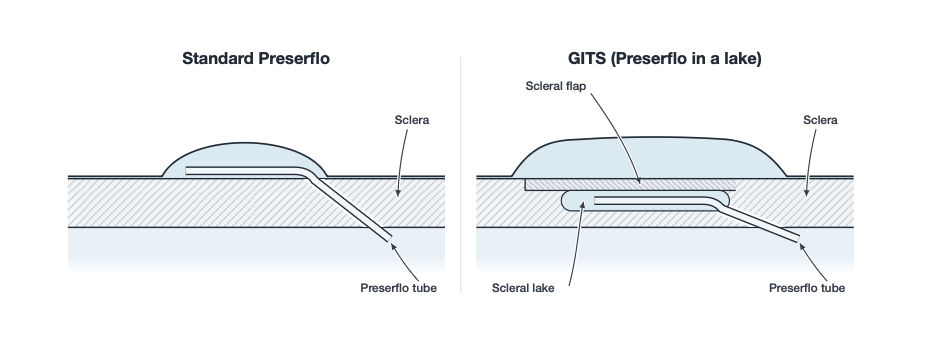
Every operation that drains fluid out of the eye faces the same obstacle: the body treats a new drainage channel as a wound and heals it, and healing means scar tissue. That is the commonest reason glaucoma drainage surgery stops working — in published series of the small stent procedures, a third or more of eyes have needed a further procedure to keep the drainage open.
That is the problem GITS was designed around. If the tube sat inside the wall of the eye rather than under the surface, it would be separated from the cells that drive scarring, and the fluid would spread out rather than pool against one point.
I should say plainly that this is a technique I developed and first carried out at University Hospital Southampton, and have since written up with colleagues. That is why I can explain the thinking behind it, and why you should weigh it alongside the advice of your own consultant.
GITS is generally considered when your pressure is no longer controlled by drops or laser, or when your consultant judges it needs to be lower than drops are likely to achieve given the damage already present.
It may be particularly relevant if you have had drainage surgery before that has scarred over and stopped working, since scarring is what this technique sets out to resist.
For now, GITS is offered at Newmedica Hampshire rather than across the network.
It is not right for every eye, though, and whether it suits you is decided in clinic, after your eye has been examined and your scans and pressure history reviewed — not from a web page. Use this one to ask better questions at your appointment.
These are different operations for different situations rather than better and worse ones. The right choice depends on how far your pressure needs to come down, what you have already had, and the condition of your eye — and on where you are seen, since not every Newmedica clinic offers all of them.
Laser treatment (SLT) is not surgery. A pulse of light improves the eye’s own drainage, it is done in clinic, and recovery is minimal. The pressure reduction is modest and can wear off, so it is often a first step rather than a final one.
Trabeculectomy is the long-established operation and remains the benchmark for lowering pressure substantially. A guarded channel under a flap drains fluid into a small blister, called a bleb, under the upper eyelid. It works well but asks more of you: longer recovery, close follow-up, and sometimes further treatment to stop the channel scarring.
Tube and shunt surgery uses a larger drainage device with a plate stitched to the wall of the eye, usually for complex glaucoma or eyes where previous surgery has failed.
Minimally invasive procedures and stents are smaller and quicker, often done at the same time as cataract surgery, with a gentle recovery. In exchange, the pressure reduction is usually smaller.
GITS uses a stent of the kind used in the minimally invasive procedures, but places it within the wall of the eye beneath a flap. The aim is a pressure reduction closer to the larger operations, with the scarring problem designed out rather than treated afterwards.
You will be awake. The eye is numbed with an anaesthetic injection around it, so you will not feel pain, though you may be aware of pressure or of water running across your face. You will not see the operation in any detail — most people describe lights and vague movement.
The operation usually takes 30 to 45 minutes. It is a day case, so you go home the same day with a pad and a protective shield over the eye. You will need someone to drive you home and, ideally, to stay with you that first night.
Your vision will be blurred at first. This is expected, not a sign something has gone wrong. It usually settles over four to eight weeks, sometimes longer.
Sleeping. On your back, or the side opposite the operated eye. Wear the shield at night for two weeks so you cannot rub the eye in your sleep.
Driving. Not until your vision meets the DVLA standard and your consultant says it is safe — usually weeks rather than days. Tell your insurer you have had eye surgery.
Work. Desk-based work is usually possible after about two weeks; physical, dusty or outdoor work needs four weeks or more. I would rather discuss your own job than give one number.
Your drops will change. Glaucoma drops in the operated eye are usually stopped straight after surgery, which surprises people. Instead you use anti-inflammatory and antibiotic drops for several weeks on a reducing schedule, and that schedule matters — it is part of how we stop the drainage scarring. Unless told otherwise, carry on with the drops in your other eye as before. You will also be seen often early on, which is how we catch problems while they are small.
Every glaucoma operation carries risk, and these are the ones I discuss in clinic. The pressure can drop too low in the first days or weeks, which usually settles on its own. Fluid can collect behind the retina — this happened to a small number of patients in the early GITS series and resolved each time without further surgery. Bleeding and inflammation are possible, and infection is uncommon but serious, which is why you should contact us the same day if the eye becomes painful or red or your vision drops. The operation may also not lower your pressure enough, or lose its effect over time, in which case you may still need drops or a further procedure.
It is worth putting the newness of GITS in context. It is not an untested idea, but a combination of two well-established operations: deep sclerectomy, which surgeons have performed for decades, and the small drainage stents that have been in routine use for years. What is new is putting the two together.
Even so, a new combination is a new operation. I first performed GITS in 2023, so my earliest patients have now passed two years of follow-up, and the technique was published in 2025. That is a reasonable body of experience, but it is not the decades we have for trabeculectomy, and GITS has not been compared against it directly in a randomised trial. You are entitled to know where the evidence stands before agreeing to any operation, and to ask me about it.
If you would like to discuss your surgical options, ask your optometrist or GP to refer you, or arrange a private appointment directly.


1st July, 2026
Read more