An intraocular lens (IOL) is an artificial lens that replaces the eye’s natural lens. The most common reason for needing an intraocular lens is cataract surgery.
During this procedure, the patient’s cloudy lens (cataract) is removed and replaced with an intraocular lens to restore clear vision. Intraocular lenses can also be used during refractive lens exchange to correct certain vision issues, such as hyperopia (farsightedness) and myopia (nearsightedness).
Request your free private cataract consultation today
Complete the form below and we'll contact you to arrange your free consultation.
Intraocular lens types
There are several types of intraocular lenses, each designed to meet different vision and lifestyle needs. Below is an overview of the main types of lenses to help you understand your options.
Monofocal lenses
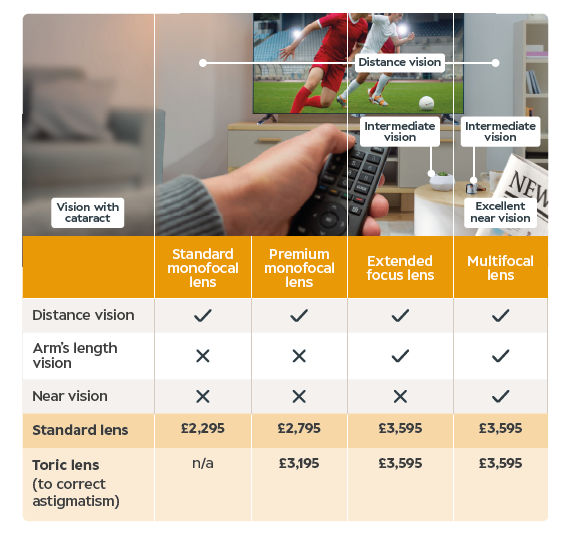
Monofocal lenses improve vision for a specific distance (such as close up or far away). Most patients choose distance vision, enabling them to see far away objects more clearly. However, glasses may still be needed to see objects close up. Monofocal lenses are the standard replacement used for cataract surgery on the NHS, but they’re also available privately.
Who are monofocal lenses suitable for?
Monofocal lenses are the most basic and therefore the most affordable type of IOL.
They’re ideal for people who have difficulty seeing clearly at a single distance, or those who don't mind using glasses to correct their vision at other distances.
Premium monofocal lens
Premium monofocal lenses work in a similar way to a standard monofocal lens, but in comparison, they’re usually made of better quality materials and offer advanced visual outcomes. They’re not available on the NHS.
Who are premium monofocal lenses suitable for?
A premium monofocal lens provides excellent distance and functional intermediate vision. While patients usually still require glasses for clear near vision, premium monofocal lenses are suitable for those who want sharp distance vision for activities like driving and watching TV, or sports like cycling and golf.
Standard IOLs usually only improve vision for a specific distance, but extended focus lenses provide a continuous focus over a range of distances, particularly intermediate and far. Your dependence on glasses is likely to be reduced, but you may still need them for very close-up work, such as sewing or reading small print.
Who are extended focus lenses suitable for?
Extended focus lenses are ideal for those who need to focus on objects around an arm's length away, but who cannot do so without straining their eyes or wearing glasses. Because they provide a smooth transition from distance to intermediate vision, they’re well-suited to people who frequently do activities like computer work and cooking, or hobbies like painting and music.
Multifocal lenses are designed to help you see over multiple distances, and can significantly reduce the need for glasses. There are different types of multifocal lenses available, including:
Bifocal: These provide clear vision over two distances, usually near and far.
Trifocal: These help people see over three distances, including near, intermediate, and far.
Toric multifocal lenses: Toric multifocal lenses are specifically designed for those with astigmatism to address additional issues, such as blurred or distorted vision.
Who are multifocal lenses suitable for?
Multifocal lenses allow you to see both distant and near objects clearly. Because of this, they’re typically beneficial for those with an active or visually varied lifestyle, where switching between tasks such as using a computer, driving and reading is common.
Multifocal lenses may be unsuitable for people with serious degenerative eye conditions like AMD. Vision loss from these conditions may mean the benefits of this type of lens are short-lived.
Toric lenses are a type of corrective lens designed for people who have astigmatism. This is a common condition where the cornea at the front of the eye is shaped more like a rugby ball than a football.
Who are toric lenses suitable for?
These are most suitable for people whose astigmatism affects their everyday vision, such as causing eyestrain or blurriness. If you’re unsure, one of our eye specialists can advise on whether a toric lens would be beneficial to you.
At Newmedica, standard monofocal lenses start from £2,295. They’re also available on the NHS at no additional cost to you if you meet the eligibility requirements. However, premium lenses aren’t routinely available on the NHS, but going private means you’ll be able to choose from a range of specialist lenses, which differ in cost.
The price of premium lenses starts from:
Premium monofocal lens: from £2,795 (toric lens from £3,195)
Extended focus lens: from £3,595 (toric lens from £3,595)
Multifocal lens: from £3,595 (toric lens from £3,595)
For cataract surgery, we offer a single fixed price, so there aren’t any hidden fees for diagnostic tests or consultations to surprise you. This means you’ll pay one price for your replacement lens, all pre- and post-operative appointments, surgery, and all medication.
we offer a range of lens options to meet your lifestyle and preferences. Our eye specialists will help you explore different options so you can come to a decision about which one is right for you. We provide the highest-quality lenses to help our patients achieve the best clinical results and reduce the chances of posterior capsular opacification (PCO), a common complication of cataract surgery. Ask for a referral or book a private appointment today to find out which IOL lens is best for you.
Lens FAQs
Premium lenses aren’t routinely available on the NHS. The standard replacement used on the NHS for cataract surgery is called a monofocal lens, which improves vision for a specific distance (far away or up close). Going private means you can choose from a range of premium lenses.
This largely depends on the type of lens you choose.
Monofocal: Because monofocal lenses and premium monofocal lenses correct vision for a specific distance, many people still need glasses for tasks at distances their lens isn’t set for.
Extended-focus lens: Your dependence on glasses is likely to decrease, but you might still need them for very close-up work, like sewing or reading small print.
Multifocal lenses: Out of all the intraocular lenses, this type of lens has the greatest potential for people to go glasses-free. This is because multifocal lenses offer the broadest possible range of vision in a single lens.
Toric lenses are designed to correct astigmatism and can be incorporated into most lens types.