Monofocal lenses are the standard type of intraocular lens (IOL) used in most cataract surgeries, and they're available both through the NHS and privately.
At Newmedica, our experts will explain the best lens types for your specific needs after examining your eyes, but you can find general information about monofocal lenses below.
Request your free private cataract consultation today
Complete the form below and we'll contact you to arrange your consultation.
This page has been reviewed by Mr Nigel Kirkpatrick MD, FRCOphth, Medical Director and Consultant Ophthalmologist - on June 18th, 2026
What are monofocal lenses?
During cataract surgery, the misted natural lens of the eye is removed, and a clear IOL is put in its place. Monofocal lenses are a type of IOL that also improve vision over a specific distance. In most cases, they improve distance vision, allowing patients to see far-away objects more clearly. However, glasses may still be needed to see things up close.
Who are monofocal lenses suitable for?
Monofocal lenses are the most basic and affordable type of IOL. They're ideal for people who only have vision trouble at one particular distance, or those who don't mind wearing glasses to correct their vision at other distances.
What vision problems do monofocal lenses correct?
Cataracts
Cataracts are when the natural lens inside the eye becomes cloudy and stiff. This is a very common condition that's usually painless, but over time it can make it very difficult to see clearly. The condition is fixed by a short surgery that involves swapping the clouded lens for a new clear one, such as a monofocal lens.
Nearsightedness
Nearsightedness happens when the eye is too long or curved, which causes light reflecting off faraway objects to focus before it reaches the back of the eye. It's like if you set up a film projector too far away from the screen; the image isn't clear. This is usually corrected by glasses or contact lenses, but monofocal lenses can also ensure the light focuses where it needs to.
Farsightedness
Farsightedness is when the light from nearby objects hasn't focused by the time it reaches the back of the eye. It's caused by the eye being too short or flat, and it makes up-close tasks like reading or using computers difficult without wearing corrective glasses or contacts. Although not as common, some monofocal lenses are designed to correct farsightedness.
Here’s how monofocal lenses work
Monofocal IOLs work the same way as the lenses in glasses. They are carefully shaped so that incoming light from a particular distance bends and is focused properly on the retina. However, like glasses, their shape is fixed, so they only correct vision over the specific distance they were designed for.
Benefits of monofocal lenses
Clearer, more vibrant vision
Cataract surgery is like replacing an old foggy window with a brand new clear one. With more light able to pass through, you'll not only be able to see details more clearly, but colours will appear brighter and more vibrant.
Less reliance on glasses
With monofocal lenses improving your sight, you'll no longer need to rely on glasses to correct your vision over the distance they're designed for. However, you may still need glasses to help over other distances.
Less hassle
IOLs are designed to be a permanent solution, unlike glasses or contacts which must be replaced over time. As a permanent part of your eye, you won't need to put them on every day, and they don't need to be cleaned or maintained.
Easy adjustment after surgery
The eye's natural lens adjusts itself based on the distance you're focusing on, which is why nearby objects appear out of focus when we look at something far away. However, IOLs are fixed in place, so your brain has to work out what should be in focus and what shouldn't. This can take some getting used to, but it's usually quick and easy with monofocal IOLs as vision is always in focus at one distance.
What are premium monofocal lenses?
Premium monofocal lenses work in a similar way to the standard monofocal lens but are often made of better quality materials and can offer clearer vision. These lenses are not available under the NHS.
How much do monofocal lenses cost?
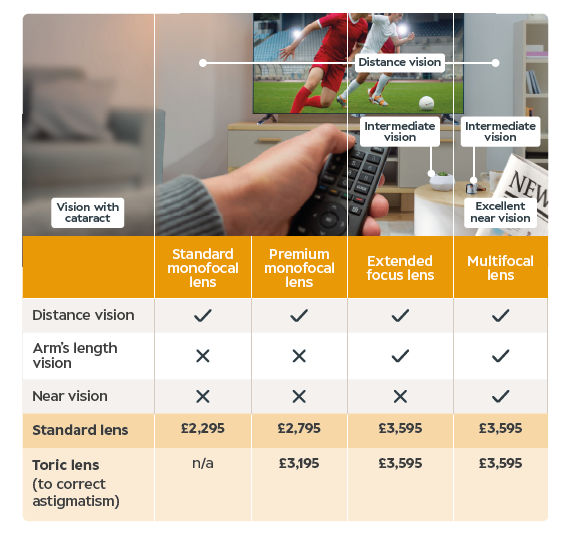
At Newmedica, standard monofocal lenses cost £2,295 per eye, although they are available under the NHS at no additional cost to you if you meet the eligibility requirements. This usually includes undergoing an assessment to determine the impact of your cataracts on your everyday life.
For private patients, we also offer premium monofocal toric lenses at a cost of £3,195 per eye. These lenses are specially designed to improve vision affected by astigmatism, as well as cataracts and nearsightedness.
Choosing your lens with Newmedica
Whether you're coming to us through the NHS or privately, we're proud to offer you the highest quality hydrophobic lenses here at Newmedica. With our proprietary lens design, you're much less likely to experience post-surgery complications like PCO, resulting in clearer vision for longer and a reduced need for additional treatment. In addition to standard monofocals, you can choose premium lenses including toric, extended focus and multifocal lenses.