Complete the form below and we'll contact you to arrange your consultation.
This page has been reviewed by Mr Nigel Kirkpatrick MD, FRCOphth, Medical Director and Consultant Ophthalmologist - on June 18th, 2026
What are extended focus lenses?
Extended focus lenses (EDOF) are a type of intraocular lens, meaning they are used as a clear replacement for your eye's natural lens if it becomes clouded by cataracts. Like other IOLs, they're also designed to help improve your vision. EDOF lenses help you see more clearly over both intermediate and far distances, whereas standard IOLs usually only improve distance vision.
Who are extended focus lenses suitable for?
EDOF lenses are most suitable for people who need to focus on objects around an arm's length away, but who cannot do so without wearing glasses or straining their eyes. That includes people who work at desks or on computers, people who cook, and those who regularly enjoy hobbies like playing music and painting. Because extended focus lenses improve intermediate vision, they enable people to do these things without glasses or straining.
What vision problems do extended focus lenses correct?
Cataracts
Like other IOLs, the primary vision problem that EDOF lenses correct is cataracts. This is a common condition that people usually experience as they age, and it involves the natural lens at the front of the eye becoming increasingly cloudy. This can obscure vision enough to interfere with everyday life, at which point the lens is replaced by an IOL during a quick surgery.
Presbyopia
Presbyopia is the reason many people start needing reading glasses around middle age. It is the loss of the eye's ability to focus on nearby objects, and it occurs because the eye's natural lens becomes stiffer over time.
Reduced intermediate vision
Stiffening of the eye's lens can also make your intermediate vision blurry, which can lead to difficulty performing tasks that take place around an arm's length away. Although near and distance vision get more attention, reduced intermediate vision affects many everyday tasks, like using computers and reading prices in shops. Extended focus lenses improve your intermediate vision in addition to your distance vision, which is typically improved by most IOLs.
Astigmatism
This is a common condition where the front of the eye is not spherical like a ball, making it slightly curved like a rugby ball. This causes vision problems like blurriness and halos around lights. It can be corrected by a special type of IOL called a toric lens, and extended focus lenses are also available as toric lenses.
Here’s how extended focus lenses work
Standard monofocal lenses are designed to focus all incoming light at one small point at the back of the eye. The result is sharp vision over one distance, with everything else looking blurry. EDOF lenses work the same way, but the area they direct light to at the back of the eye is broader. You could think of it like the difference between a torch and a laser.
This results in clear vision over a wider range of distances and a more natural visual experience compared to other types of IOL.
What to expect after extended focus lens surgery
In the long run, you can expect extended focus lenses to offer clear intermediate and distance vision. Although there can be some improvement to near vision, you may still need glasses for tasks like reading small print. You won't notice the lenses themselves, as they'll just feel like a natural part of your eye.
However, there is often a short adjustment period after the surgery. Your eye will take a few weeks to fully heal, and your brain has to adjust to a new way of seeing. You might notice some visual disturbances early on while this process takes place, but your vision will gradually improve and stabilise.
Benefits of extended focus lenses
Clear vision across multiple distances
Standard monofocal lenses only deliver sharp vision at one specific distance, but extended focus lenses help you see clearly across multiple ranges. This includes your intermediate and distance vision ranges, which are required for all kinds of everyday activities.
Less reliance on glasses
While wearing glasses isn't a big problem for most people, being reliant on them can cause problems if they get broken or forgotten. With EDOF lenses, you'll likely find that you can perform most of your daily tasks without them, including driving, cooking, shopping and desk work. You won't have to worry as much about not having your glasses to hand.
A more natural visual experience
Some patients find that the visual experience of EDOF lenses is similar to how they saw before they started having problems, especially compared to other IOLs. For example, monofocal lenses leave everything blurry except for one specific distance.
Low maintenance
Extended focus lenses are designed to be a long-term solution, and there's no maintenance to worry about. You don’t need to regularly clean or replace the lenses like you do with glasses.
Limitations
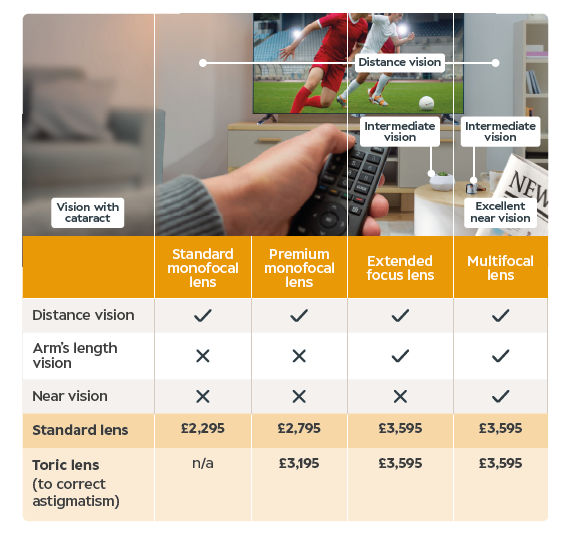
While EDOF lenses provide clear vision over a broad range of distances, it's not uncommon to still need glasses for very close-up tasks. If clear near vision without glasses is a priority, multifocal lenses focus at near, intermediate and distance, though your consultant can talk through your options. Another limitation is that your vision with them may not be perfect. They're designed to offer a good level of clarity over various distances, but this may not be quite as sharp as what a monofocal lens can deliver over the distance it's designed for.
The benefits an extended focus lens can offer may also be limited in patients with other serious eye conditions. The vision problems caused by macular degeneration and certain other conditions often eclipse the benefits of premium IOLs.
Cost of extended focus lenses
At Newmedica, we offer high-quality extended focus lenses in two different types. Both the standard and toric options cost £3,595 per eye. Book a private appointment with us today for expert advice on the best lens choice for you.