As a private cataract surgery patient with Newmedica, you'll be able to choose from a range of intraocular lenses (IOLs) designed to correct common vision problems as well as cataracts.
Our experts will discuss all the suitable options for you after your initial assessment. Depending on what other eye conditions you have, such as astigmatism, toric lenses (toric IOLs) may be one of your choices. You can learn more about who they're for and how they work below.
Request your free private cataract consultation today
Complete the form below and we'll contact you to arrange your consultation.
This page has been reviewed by Mr Nigel Kirkpatrick MD, FRCOphth, Medical Director and Consultant Ophthalmologist - on June 18th, 2026
What are toric lenses?
Toric lenses (toric IOLs) are a type of intraocular lens used to replace the eye's cloudy natural lens during cataract surgery. What makes them different from standard lens types is that they correct for astigmatisms. This is a common condition where the front of the eye is not spherical like a ball, making it slightly curved like a rugby ball. This causes the light to scatter more when it enters the eye.
How do toric lenses work?
The lens is designed to counteract the scattering of the light with some areas of the lens stronger than others. The lens that is used is specific to your eye meaning that light focuses correctly on the back of the eye. Special equipment is also used during surgery to ensure they're positioned at exactly the right angle for the shape of the patient's eye.
Who should use a toric lens?
Toric lenses are not necessary for all cataract patients. They are most suitable for those whose astigmatism affects their everyday vision, such as by causing blurriness or eyestrain. The eye specialist will be able to advise you if you would benefit from a toric lens.
Benefits of toric lenses
Greater visual clarity
Like other IOLs, toric lenses are used to replace the eye's natural lens when it becomes clouded by cataracts. The new lenses are completely clear, resulting in an immediate improvement in visual clarity.
Reduced dependence on glasses
Astigmatism causes additional vision problems that are not corrected by standard IOLs, so people with the condition usually still need glasses for activities like driving, reading and using computers. However, the special design of toric lenses corrects both distance vision and astigmatism, meaning patients no longer need to wear glasses as much.
Better vision in low light
The effects of astigmatism are often more pronounced in low light conditions, and driving at night can be especially dangerous. Objects are often blurrier, distances are harder to judge, and light sources such as streetlamps and headlights may appear to have halos around them. Toric IOLs reduce these effects and make nighttime driving safer and less stressful.
Reduced lifetime cost and hassle
As a premium option, toric lenses cost more upfront than standard IOLs, but they offer great value in the long run. The surgery is only performed once, and it can save you from decades of glasses or contact lens costs.
What vision problems does a toric lens correct?
Astigmatism
Astigmatism is a common condition where the cornea or lens of the eye is an irregular shape. Instead of the surface being evenly curved like a sphere, it's more steeply curved in some spots than others, like a rugby ball or an egg. Instead of focusing light into one point at the back of the eye, it scatters it, resulting in blurred vision.
Nearsightedness
Nearsightedness, also known as shortsightedness or myopia, is also caused by the eye being irregularly shaped. In this case, the shape causes light reflected from distant objects to focus in front of the retina rather than directly on it, making them appear blurred.
Farsightedness
Farsightedness, or hyperopia, is essentially the opposite of nearsightedness. Light entering the eye from nearby objects focuses behind the retina, making them appear blurry.
What to expect when wearing a toric lens?
With your cataracts gone, you can expect to see much more clearly, and with a toric IOL, you'll notice fewer symptoms of astigmatism like blurriness, squinting, eyestrain and headaches. You won't notice the lenses themselves, as IOLs are not like contact lenses. They become a part of your eye rather than sitting on top of it.
Like other IOLs, toric lenses can also correct vision over various distances. A monofocal toric lens is designed to restore sight over one specific distance (such as far away), while multifocals restore the ability to clearly see objects that are nearby, at arm's length and far away.
How much does a toric lens cost?
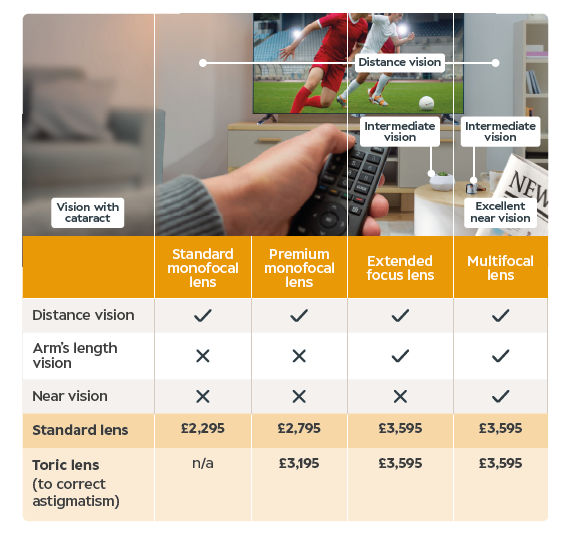
The cost of a toric lens depends on the type of lens chosen, i.e. monofocal or multifocal. Here at Newmedica, we offer three different choices:
Premium monofocal toric lenses: £3,195 per eye and correct distance vision only.
Extended depth of focus toric lenses: £3,595 per eye and correct both arm's length and distance vision.
Multifocal toric lenses: £3,595 per eye and correct near vision, arm's length and distance vision.
Toric lenses at Newmedica
If you're thinking about getting toric lenses, there's nowhere better than Newmedica. Our consultants have over 10,000 cataract procedures under their belts, and you'll be able to choose the exact one who'll carry out your surgery in one of our comfortable, modern clinics. As well as being confident you're receiving the best care, you'll also have the latest lens technology to choose from and only a short wait for your surgery.