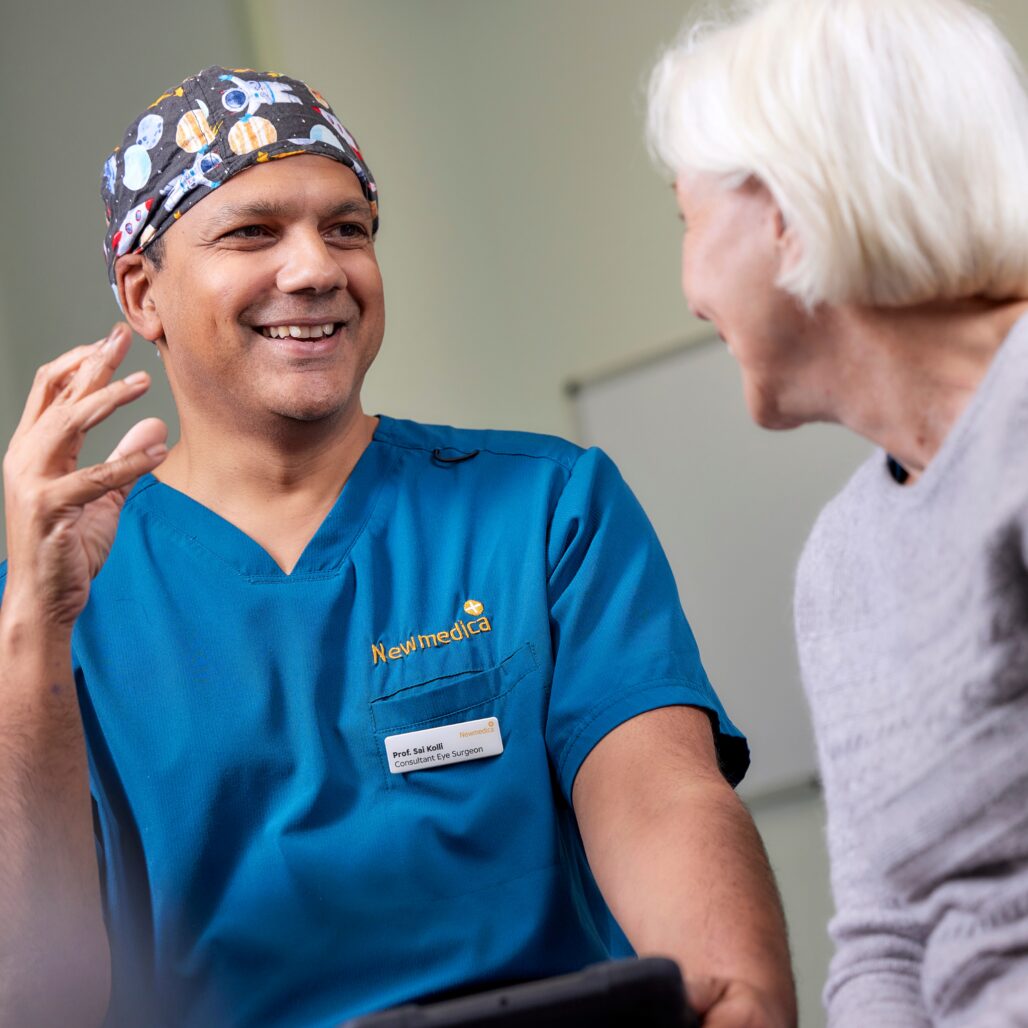
They all spoke to me calmly and explained what would be happening. They were amazing.
Sarah’s story
You can have NHS oculoplastic surgery with us here at Newmedica. Read on to learn more about NHS treatment and whether it's right for you.
Oculoplastic conditions affect the areas around the eyes, such as the tear ducts, eyelids, and the orbit (the bony socket that holds your eye). NHS oculoplastic surgery addresses problems like these to improve vision and eye function. Generally, the NHS provides oculoplastic surgery for medical reasons rather than for cosmetic purposes. For example, this may include drooping eyelids that obstruct your view or blocked tear ducts that prevent tears from draining properly.
If your optician or GP suspects or diagnoses you with an oculoplastic condition, they will explain all your treatment options and tell you where you can receive care on the NHS. Once you’ve chosen where you want to receive your NHS care, such as with us at Newmedica, arrangements will be made for your referral.
Once referred, you’ll have an appointment where eligibility for NHS treatment will be determined. This usually includes assessing the severity of your condition and its impact on your daily life.
If eligible, you’ll be added to an NHS waiting list. NHS waiting times vary depending on a range of factors, such as demand and capacity. At Newmedica, our waiting times are short.
Eyelid conditions can cause discomfort, affect vision, and lead to complications. Common eyelid conditions include:
Entropion (inward-turning eyelid): This happens when the edge of the lower lid turns inwards, causing the eyelashes to touch or rub against the surface of the eye, leading to irritation.
Ptosis (drooping eyelids): Excess upper eyelid skin (dermatochalasis) or weakening of the muscle that lifts the eyelid (ptosis) can cause the upper eyelid to droop. In some cases, a drooping eyelid can obstruct vision.
Ectropion (outward-turning eyelid): This can affect one or both eyes and occurs when the lower eyelid turns outward, away from the eye. It disrupts tear drainage, making the eye sore, watery, red, or gritty, and more vulnerable to infections such as conjunctivitis.
Eyelid reconstruction: Following damage, eyelid reconstruction can restore the function and appearance of the eyelids. This may be necessary after trauma, cancer removal, or other medical conditions affecting the eyelid.
A number of conditions can also show up as eyelid lumps and bumps. Symptoms can range from a red, painful infection in the eyelid, like a stye, or a very gradual development of a painless lump on or in the edge of the eyelid. Many eyelid bumps are harmless, but may be removed on the NHS if they’re affecting eye function or causing other issues.
If a tear duct is blocked, tears cannot drain properly, leading to symptoms like watery eyes, pain around the tear duct, discharge from the eye, and blurred vision. In some cases, blocked tear ducts can lead to an infection known as dacryocystitis, which can cause symptoms such as pain, swelling, and redness.
This procedure involves removing excess fat or skin from the upper or lower eyelids. While blepharoplasty is often performed for cosmetic purposes, the NHS only provides it when it is considered medically necessary, such as if a drooping eyelid is affecting vision.
Dacryocystorhinostomy is a procedure used to treat blocked tear ducts, allowing tears to drain properly. It involves creating a new pathway for tears to drain between the eyes’ lacrimal sac and the nose.
The NHS may provide other treatments for oculoplastic conditions if it’s medically necessary. For example, eyelid lumps and bumps can be removed with a small procedure under local anaesthetic if they’re causing functional problems or discomfort.
NHS oculoplastic surgery addresses issues around the eyes that affect or obstruct vision, such as drooping eyelids, helping people see more clearly. It also reduces symptoms that are causing discomfort, improving quality of life.
When the eyelids function properly, they protect the eyes and help keep them lubricated. By restoring eyelid function, oculoplastic surgery helps maintain eye health.
If left untreated, oculoplastic conditions may lead to eye infections or further complications. For example, a blocked tear duct can lead to an infection called dacryocystitis. Oculoplastic surgery addresses these issues to help protect the eye and reduce the risk of infection.
Once you’ve been referred for treatment, you’ll attend a consultation with your surgeon. To help them decide which treatment is best, you’ll discuss your eye problem, and they’ll examine your eyes and take a look at your medical history.
Once the most suitable procedure has been chosen, they’ll explain what it involves, the expected outcomes, and any possible risks. You’ll also have the chance to ask questions and address any concerns you have.
You’ll be placed on the NHS waiting list until an appointment slot becomes available for you. When this does happen, you’ll be contacted with more details. You’ll be given advice on how to prepare for your surgery, and it’s important to follow it. This may include stopping certain medications or guidance on eating and drinking. Most patients go home on the same day as their oculoplastics surgery. However, you won’t be able to drive home.
You’ll be given aftercare advice to follow, and appointments will be arranged to monitor your recovery.
At Newmedica, we’ll call you 24 hours after your surgery and provide access to a 24-hour aftercare helpline.
It’s normal to experience temporary side effects following oculoplastic surgery, such as bruising, swelling, watery eyes, mild irritation, and light sensitivity, but these usually subside within 2-3 weeks.
Oculoplastic procedures are generally safe, but every surgery carries risks. Potential risks depend on the procedure, but could include bleeding, infection, asymmetry, and side effects from the anaesthesia. You’ll be told about possible risks in more detail before you undergo your surgery.
If approved for oculoplastic surgery, you’ll be added to an NHS waiting list. If you’re on an NHS waiting list, you also have the right to ask to go to a different clinic or hospital if you prefer. At Newmedica, our waiting times are shorter and you will always be treated by a specialist, so you can get back to doing what you love.
We’re proud to be an NHS Choice Provider, working in partnership with the NHS, local opticians and GPs to ensure our communities receive high-quality care to protect their sight, and to help take some pressure off busy NHS hospitals.
Our modern clinics, located across England, have been designed to provide a calm and comfortable space. They all have the latest facilities and equipment to give you the best possible experience. Our dedicated, expert team are committed to delivering healthcare to the highest standard, and they’ll always take the time to answer any questions you have and ensure you stay informed throughout your journey with us.
If your optician or GP suspects or diagnoses you with an oculoplastic eye condition, they will explain all your treatment options as well as where you can receive NHS care. If you choose Newmedica for your surgery, just let them know, and they’ll organise your referral in line with the locally commissioned NHS pathway.


I can’t fault the service at Newmedica. It was amazing. Everyone was so helpful, the surgery was so quick and efficient.
Joan’s story
Read story

‘I love cooking, and now I can actually see what I’m doing in the kitchen again. Suddenly I’m able to cook my older recipes with the family.
Karen’s story
Read story
I had a first-class experience and can’t praise the team enough. I have worn glasses for a long time but my sight is so clear and sharp.
Allen’s story
Read story