
They all spoke to me calmly and explained what would be happening. They were amazing.
Sarah’s story
Refractive lens exchange (RLE) replaces your eye’s natural lens with an artificial one to correct short-sightedness, long-sightedness, astigmatism and age-related near vision problems. It’s often a good fit if you’re over 50 or not suitable for laser eye surgery, and it can reduce how much you rely on glasses.



I can’t fault the service at Newmedica. It was amazing. Everyone was so helpful, the surgery was so quick and efficient.
Joan’s story
Read story

‘I love cooking, and now I can actually see what I’m doing in the kitchen again. Suddenly I’m able to cook my older recipes with the family.
Karen’s story
Read story
I had a first-class experience and can’t praise the team enough. I have worn glasses for a long time but my sight is so clear and sharp.
Allen’s story
Read story
Your surgeon replaces your natural lens with a clear, high-quality one. We’ll talk you through every option, but here’s a quick guide to the lenses available to private patients.
Monofocal lens
One focus point, so it corrects your vision for distance or near, but not both.
Extended depth of focus lens
Clear vision from arm’s length to distance. You’ll probably need glasses less, but may still need them for close work like small print or sewing.
Multifocal lens
Several focus points give clear vision up close, at arm’s length and at distance. It significantly reduces your need for glasses.
Toric lenses
Each lens above comes in a toric version that also corrects astigmatism (blurred vision caused by an irregularly shaped eye).
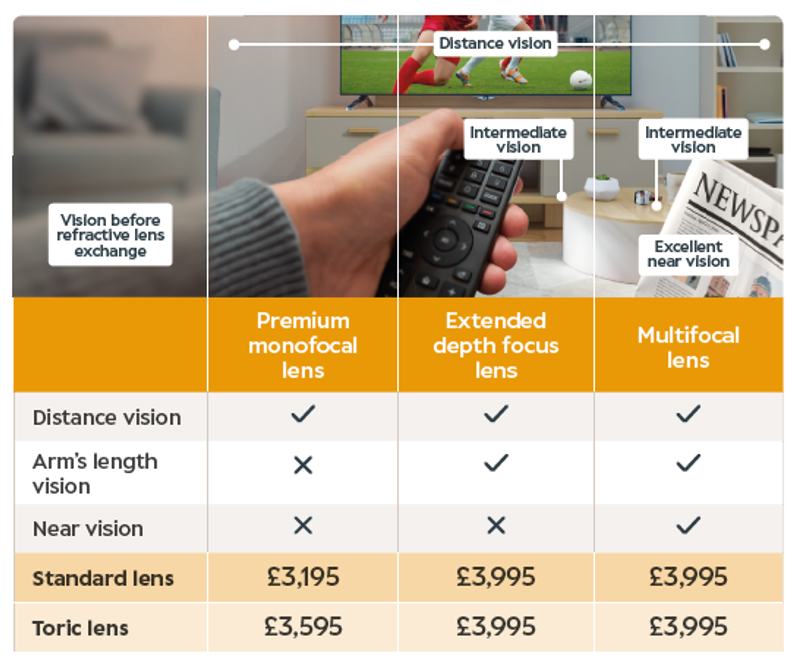
Prices from £3,195. Find your nearest clinic to book.
Your first consultation costs £195, is non-refundable and is paid at the appointment. If you go ahead with treatment, we take it off your final bill. The balance is due before your procedure.
RLE is usually recommended if you want to correct your vision and rely less on glasses or contact lenses, but you aren’t suitable for laser surgery such as LASIK or PRK. Those treatments reshape the cornea, the clear window at the front of the eye.
It may also suit you if you have early signs of lens dysfunction, such as losing near vision or contrast sensitivity, and want a long-term fix.
It’s often considered for people over 50, especially those with presbyopia or those who struggle with both near and distance vision.
Refractive lens exchange is typically recommended for patients who wish to correct a refractive error which, in turn, will reduce their dependence on glasses or contact lenses and who are not suitable candidates for refractive laser procedures such as LASIK or PRK (procedures that reshape the clear window at the front of the eye, the cornea, to correct vision problems such as near-sightedness, far-sightedness and astigmatism).
It may also be advised for patients with early signs of lens dysfunction (loss of near vision or contrast sensitivity, for example) who are seeking a long-term solution for vision correction.
This procedure is often considered for individuals over the age of 50, particularly those with presbyopia (loss of nearby focusing power with age) or those experiencing difficulty with both near and distance vision.
We offer patients access to leading consultants who are also partners in the business, meaning they’re directly involved in setting our high standards of care.